Microeconomics vs Macroeconomics
Micro:
- Study of how household and firms make decisions and how they interact in the market.
- Supply and demand market structures
Macro:
- Study of the major components in the economy
- International trade, inflation, and wage laws.
Positive vs. Normative Economics
Positive:
- An attempt to describe the world as is
- Very Descriptive in nature
Normative:
- Claims that attempts to prescribe
- Ex: Government should raise the minimum wage
Wants vs. Needs
- Want - a desire
- Need - necessity for survival
Scarcity vs. Shortage
- Scarcity - most fundamental economic problem a society faces
- Satisfying unlimited wants with limited resources
- Shortage - situation in which quantity demanded is greater than quantity supply
Goods vs. Services
- Goods - tangible commodities
- Capital goods: items used in the creation of other goods, such as factory machinery and trucks
- Consumer goods: goods that are intended for final use by the consumer
- Services - work that is performed for someone
Factors of Production
- Land - Natural Resources
- Labor - Work exerted
- Capital
- Physical - human made objects used to create other goods
- Ex: Buildings and tools
- Human - Knowledge and skills a worker gains through education and decisions
- Entrepreneurship
Opportunity cost - most desirable alternative given up by making a decision
PPC -Production possibility Curve
PPF - Production possibility Frontier
PPG - Production Posibility Graph
- A curve depicting all maximum output possibilities for two or more goods given a set of inputs (resources, labor, etc.). Assumes that all inputs are used efficiently
- Shows alternative ways to use resources, each point reflects a trade off
- Graphs are concave (bowed out)
4 Assumptions
- Fixed Technology
- Fixed Resources
- Full Employment + product efficiency
- Two products are being considered

Points A,B, & C
- Efficient and attainable
Point D
- Inefficient and attainable
- Under utilization
- Resources
Point E
- Efficient and unattainable
- Over-extended
- Technology
Shifts:
Left:
- Decrease in work force/ work skills/ education
- Permanent loss of productive capacity
- Ex: War, taxes, government regulation
Right:
- Technological advancement
- Discovery of new resources
- Trade ( Comparative advantage)
- Economic Growth
Movements:
- Inside the PPC
- Unemployment
- Underemployed
- Outside the PPC
- Technology
- Economic growth
- Along the PPC
- Ceteris Parins - all things remain constant
Productive vs. Allocative Efficiency
Productive - Producing goods at the lowest cost
- Full employment
- Allocating resources efficiently
Allocative - Combination of the most desired products by society or those who are in charge of economic decision
- Where we want to produce on the curve
Demand and Supply
Demand:
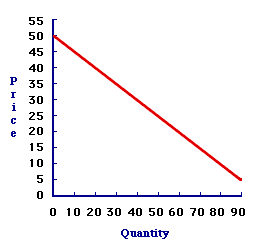
- The quantities that people are willing and able to pay at various prices
- There is an inverse relationship between price and quantity demanded
- Causes:
- A Δ in the number of buyers ( population)
- A Δ in buyer's taste (Advertising)
- A Δ in income ( inferior goods vs normal goods)
- A Δ in price of related goods ( Substitute vs Complimentary goods)
- A Δ in expectation
Supply:

- The quantities that producers or sellers are willing and able to produce or sell at various prices
- There is a direct relationship between price and quantity supplied
- Causes:
- Δ in technology
- Δ in weather
- Δ in resources or factor prices
- Δ in taxes or subsidies
- Δ in the number of suppliers
- Δ in expectations
Elasticity of Demand
- Measure of how consumers reacts to a change in price
Elastic Demand
- Demand that is very sensitive to change in price
- Product is not a necessity
- There are substitutes
- E>1
- Ex: Soda, Candy, fur coat, and steak
Inelastic Demand
- Demand that is not very sensitive to change in price
- Product is a necessity
- Few or none substitutes
- People need no matter what
- E<1
- Ex: Salt, milk, insulin, and gas
Unitary Elastic
- E=1
How to Calculate Elasticity of Demand
- New Quantity - old quantity / old quantity
- New price - old price / Old price
- % Δ in quantity demanded / % Δ in price
Total Revenue
- Total amount of money a firm receives from selling goods and services
- P(Q) = TR
Business Cycle

- Average cycle is 6 years
- Recessions last about 14 months
- The bulk of a cycle is the growth stage
- Peak and trough are meaningless because we never know we are in one until it's over
- If a recession loses more than 10% of real GDP, the it is a depression
- Trough means the end of recession
Production Costs
Fixed Costs
- Cost that does not change no matter how much is produced
- Salary, mortgage, car payment
Variable Costs
- Cost that fluctuates or changes depending upon how much is produced
- Electricity bill, water bill, marginal cost
Marginal Cost
- Cost of producing one additional unit of a good
Total Cost
- FC+VC = TC


Hey Andrew!! I really liked your blog. It has all the notes that I would need to review over what we learned in class. I also like the Alicia Keys music in the background so I can jam and chill while studying. The organization tabs are a big help to find exactly what I need. The graphics are great and interesting.
ReplyDelete