Aggregate Demand (AD)
- Relationship between price level and Real GDP
- Shows the amount of Real GDP that the private, public, and foreign sector collectively desire to purchase at each possible price level
- Relationship between price level and level of Real GDP is inverse
Reason why AD is down-slope:
- Real-Balance Effecta
- When price level is high, household and business cannot afford to purchase as much output
- When the price level is low, households and businesses can afford to purchase more output
- Interest Rate Effect
- hHgher price level increases the IR which leads to discourage investment
- lower PL decreases the IR which leads to encourage investment
- Foreign Purchase
- Higher PL increases demand for relatively cheaper imports
- Lower PL increases the foreign demand for relatively cheaper US exports
Shifts in AD:
- A change in C, IG, G, and Xn
- A multiplier effect that produces a greater change than the original change in the four components
Increase in AD - Shift to the right
Decrease in AD - Shift to the right
[C] Consumer Spending
1. Aggregate wealth increases ( houses, land, stock) [independent of PL]
2. expectations of surging future inflation
3. Consumer indebtedness is fairly low
4. Consumer taxes are decreased
5. Interest rates are decreased [ independent of PL]
- Consumer Wealth
- More wealth = more spending
- Less wealth = less spending
- Consumer Expectation
- Positive Expectation = more spending
- Negative Expectation = less spending
- Household indebtness
- Less debt = more spending
- More debt = less spending
- Taxes
- Less tax = more spending
- More tax = less spending
[IG] Investment Spending Increase
1. Interest rates are decreased [independent of
PL]
2. Positive profit expectations
3. Factory inventories are down
4. *Business taxes
- Real Interest rate (IR)
- Lower IR = more investment
- Higher IR = less investment
- Expected Returns
- Higher ER = More investment
- Lower ER = Less investment
- influenced by:
- Expectation of profitability
- Technology
- Degree of excess capacity
- business taxes
[G] Government Spending
1. Government spending increases on health care,
military bases, infrastructure, etc.
- More spending = AD shifts right
- Less spending = AD shifts left
[Xn] Net Export Spending Increases
1. Foreign incomes increase [they can afford to buy more-there and here]
2. Dollar depreciates [our exports are cheaper]
[$1 =Y150 to $1=Y100] [Both Americans and Japanese buy more american goods]
- Exchange Rate
- Strong $ = more import, few exports = AD shift left
- Weak $ = Less import, More exports = AD shift right
- Relative Income
- Strong foreign economies = more export = AD shift Right
- Weak Foreign economies = less export = AD shifts left
Aggregate Supply
- The level of real GDP that firms will produce at each price level
Long run v. Short run
- Long-run
- Period of time where input prices are completely flexible and adjust to changes in the price-level
- In the longrun, the level of real gdp supplies is independent of the price level
- Short-run
- Period of time where input prices are sticky and does not adjust to changes in the price level
- In the short-run the level of real gdp supplies is directly related to the price level
Long-run aggregae supply (LRAS)
- The LRAS marks the level or full employment in the economies ( analogous to ppc )
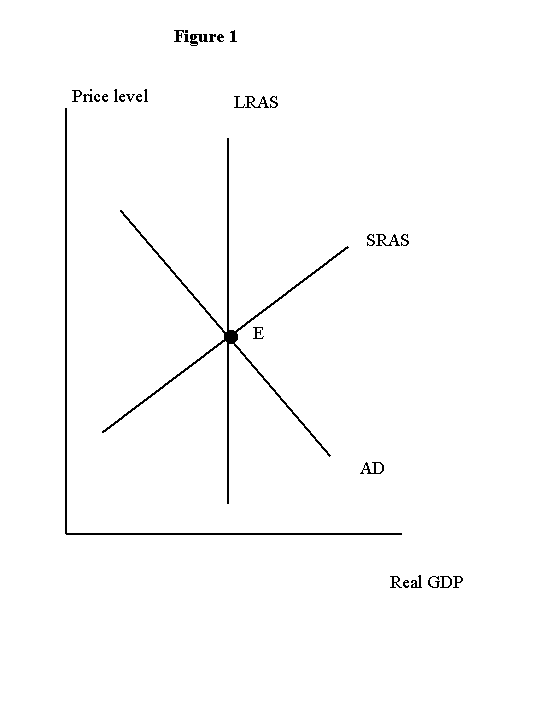
Changes in SRAS
- An increase in SRAS is seen as a shift to the right
- A decrease in SRAS is seen as a shift to the left
- The key to understanding shifts in SRAS is per unit cost of production
- Per unit cost of production cost = Total input cost / Total Output
Determinants
- Input Prices
- Land,wages, labor, entrepreneurship, capital
- Increase in Resource price = SRAS shifts left
- Decrease in Resource price = SRAS shifts right
Productivity
- = total output/ total input
- More productivity = lower unit production cost = SRAS shifts right
- Less productivity = higher unit production cost = SRAS shifts left
[R] Resource Cost Decrease (domestic)
1. Land – new raw materials (oil) are found.
2. Labor–labor force increases or wages decrease.
3. Capital stock or entrepreneurial ability increases.
4. The number of sellers of resources increase.
Resource Cost Decrease (overseas)
1. Imported resources decrease in price.
2. Dollar appreciates [$1=Y100 to $1=Y150]
3. OPEC nations cheat by producing more oil
[E]Environment
[Legal-Institutional Environment for businesses change]
1. Subsidies are increased.
2. Regulations on businesses are decreased.
3. *Business taxes decrease.
[P]Productivity Increases
- Technological breakthrough leads to an increase in productivity [more outputs from same inputs]
Ranges/Shapes/Views of AS
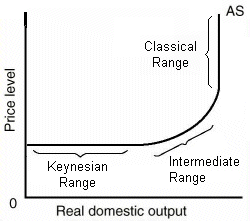
Keynsian
- Followers believe in a horizontal AS curve because when the economy is below FE, AD shifts outward
- Increase in GDP, unemployment drops, price level is constant
- Demands creates it's own supply
Classical
- In the long run, the AS curve is vertical because the only effects in the increase in AD is when we are already at FE.
- Increase in price level
- Supply creates its own demand
- (Say's Law)
Intermediate Range
- AS is between the classical and keynsian range
- AS shifts outward
- Price level and real GDP increases
AS/AD model
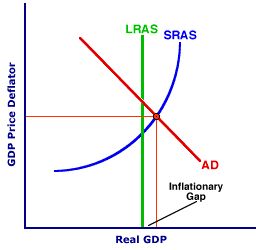
- Equilibrium of AS and AD determines current output and PL
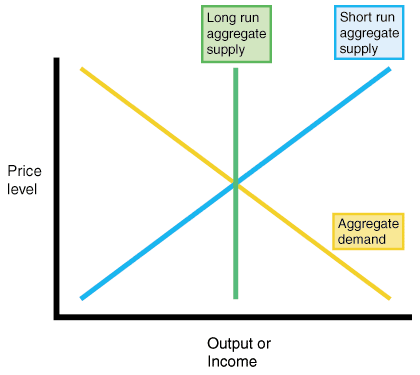
- Full Employment Equilibrium exists where AD intersects SRAS and LRAS at the same point
Recessionary Gap
- Occurs when equilibrium falls below full employment
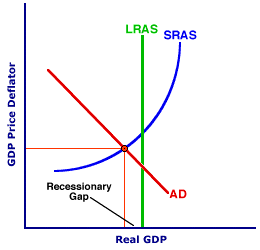
Inflationary Gap
- Occurs when equilibrium is beyond full employment
Changes in AD
- Consumption or Investment or Government Spending or Net Export INCREASES
- AD shifts right
- Real GDP increases
- Price Level Increase
- Unemployment decreases
- Inflation increases
- Consumption or Investment or Government Spending or Net Export DECREASES
- AD shifts left
- Real GDP decreases
- Price Level decrease
- Unemployment increases
- Inflation decreases
Increase in AD
Decrease in AD

Changes in SRAS
- Input Price, Productivity, or legal institution environment INCREASES
- SRAS shifts right
- Real GDP increases
- Price level decreases
- Unemployment decreases
- Inflation decreases
- Input Price, Productivity, or legal institution environment DECREASES
- SRAS shifts left
- Real GDP decreases
- Price level increases
- Unemployment increases
- Inflation increases
Increase in SRAS
Decrease in SRAS
LRAS
- Measuring potential output, assessing if all resources are used efficiently
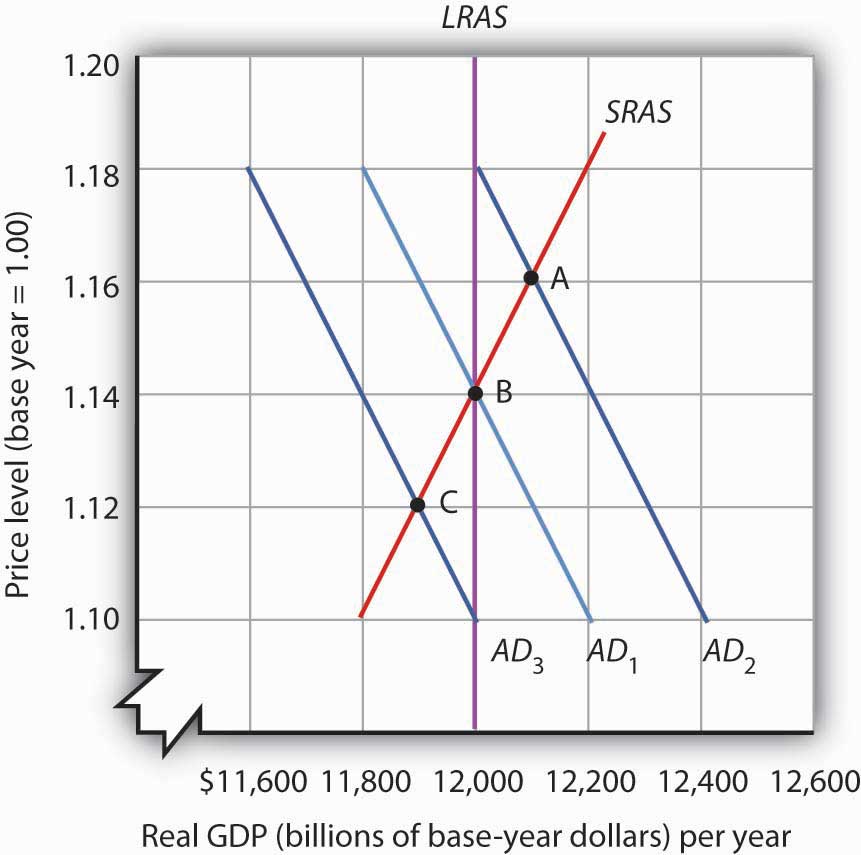
B - No pressure to raise or lower factor prices
C - Inefficient, under utilizing resources, factor prices are pressured to fall
A - Over utilizing resources, factor prices are pressured to rise
LRAS Shifts
- Technology
- Economic Growth
- Capital
- Entrepreneurship
- More resource availability
What is Investment?
- Money Spent on expenditures on:
- New plants (factories)
- Capital Equipment ( machinery)
- Technology (hardware and software)
- New homes
- Inventories (goods sold by producers)
Expected Rate of Return
- How does business make investment decisions?
- Cost/benefit analysis
- Expected rate of return
- Determine the benefit
- Count the cost?
- Interest cost
- How does determine the amount of investment they undertake?
- Compare expected rate of return to interest cost
- If ER > IR, invest
- If ER< IR, Do not invest
Real (r%) vs. Nominal (i%)
- Difference?
- Nominal is the observable rate of interest
- Real subtracts out inflation (pi%) and is only known expost facto
- How to compute r%?
- r% = i% - pi%
ID Curve
- Downward Sloping
- IR is higher, fewer investment are profitable, interest is low, more investments are profitable
- conversely, there are few investments that yield high rates of returns and many that yield low rates of return
Changes in r% cause change in Ig.
Factors other than r% may shift the entire ID curve
ID
- Cost of production
- Business tax
- technological cost change
- stock of capital
- expectation
When ID shifts, different levels of GPI occur even while r% remains constant.
Consumption and Savings
- DI ( Disposable income)
- income after taxes or net income
- save or spend
- 2 choices
- consume (Spend money)
- Save (Not spend money)
- Consumption
- household spending
- the ability to consume is constrained by:
- the amount of DI
- the propensity to save
- DI = 0 and household consume
- autonomous consumption
- dissaving
- Saving
- Household not spending
- The ability to save is constrained by:
- the amount of disposable income
- the propensity to consume
- Household save if DI = 0
- No
APC and APS ( Average propensity to consume/spend)
- APC + APS = 1
- 1-APC = APS
- 1-APS = APC
- APC > 1 : disaving
- -APS : dissaving
MPC AND MPS ( Marginal propensity to consume/spend)
- Change in consumption / Change in DI
- % of every extra dollar earned that is spent
- Change in saving / Change in DI
- % of every extra dollar earned that is saved
- MPC + MPS = 1
- 1-MPC = MPS
- 1-MPS = MPC
Determinants of Consumption and Saving
- Wealth
- Expectation
- Household Debt
- Taxes
MPC - Fraction of any change in DI that is consumed
MPS - Fraction of any change in DI that is saved
Spending Multiplier Effect
- Initial change in Spending ( C, Ig, G, Xn) raises a larger change in AD
- Multiplier = Change in AD / Change in spending
- = Change in AD / Change in C, Ig, G, Xn
Why does this happen?
- Expenditure and income flow continuously when sets off a spending increase in the economy
- + when increase in spending
- - when decrease in spending
Spending multiplier
- 1/MPS or 1/1-MPC
Fiscal Policy
- Expansionary and contractionary policy
- Deficits and surpluses
- built in stability
- Changes in the expenditures or tac revenues of the federal government
- 2 tools of fiscal policy
- Taxes - government can increase or decrease taxes
- Spending - government can increase or decrease spending
- Fiscal policy is enacted to promote our nation's economy goals: full employment, price stability, economic growth
Deficits, surpluses, and debt
- Balanced Budget
- Revenues = Expenditures
- Budget Deficit
- Revenue < Expenditures
- Budget Surplus
- Revenue > Expenditures
- Government Debt
- Sum of deficit - Sum of surpluses
- Government must borrow money when it runs a budget deficit
- Government borrows from
- Individuals
- corporation
- financial institution
- foreign entities or foreign government
Fiscal policy Two Options
- Discretionary Fiscal Policy ( action)
- Expansionary fiscal policy - Think deficit
- Contractionary fiscal policy - think surplus
- Non - Discretionary Fiscal policy (No action)
Discretionary
- Increasing or decreasing government spending and/or taxes in order to return economy to FE. Involves policy makers doing fiscal policy in response to an economic problem.
Automatic
- unemployment compensation and marginal tax rate are examples of automatic policies that help mitigate the effects of recession and inflation. Autonomic fiscal policy takes place without policy makers having to respond to current economic problems.
Contractionary Fiscal Policy
- Designed to decrease AD
- Strategy for controlling inflation
- Inflation is countered
- decrease in government spending
- increase in taxes
Expansionary fiscal policy
- Designed to increase AD
- Increase Investing, GDP
- Combating a recession and reducing unemployment
- Recession is countered
- increase in government spending
- Decrease in taxes
Progressive Tax Systems
- Average tax rate ( tax revenue / GDP ) rises with GDP
Proportional Tax System
- Average Tax rate remains constant as GDP rises
Regressive Tax System
- Average tax rate falls with GDP
The more progressive the tax system, the greater the economy built in stability


I agree with Vo's statements that AD is downward sloping because of the real balances effect, Intrest rate effect and Foreign Purchases effect.I agree because price level is on the y-axis which is usally where changes in the determinate. Overall Vo's Notes provide a outstanding outline of Unit 2 topics dealing with AD/SD graphs and etc.
ReplyDeleteHi Andrew! Your blog is very simple yet appealing, and also easy to take in information. I'd like to add some of my own thoughts or notes to your blog as well. For the Keynesian view of the aggregate supply curve, aggregate demand determines output and employment. Unemployment usually exists as well. Whenever the economy is below full employment, AD shifts outward. And as you said, there is an increase in real GDP, but the price level is constant. Thus, employment drops. As a result, this means that demand creates its own supply. Bye for now!
ReplyDelete